I Opened My Home to a Friend in Need—What Happened Next Taught Me a Valuable Lesson

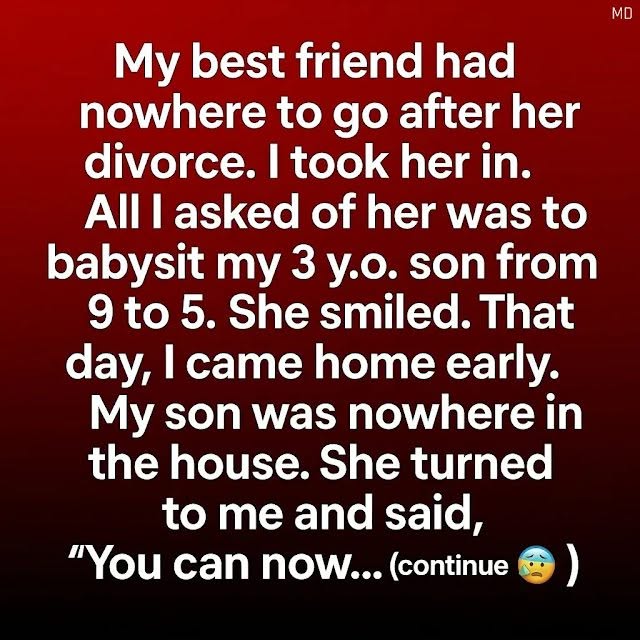
She had taken Daniel to her sister’s house without telling me.
Just for a few hours.
Her intention, she said, was to “practice independence” and “prove she could care for him properly.”
To her, it was harmless.
To me, it felt like my entire world had been moved without permission.
My son wasn’t in danger.
He was safe.
But something far more important had been broken.
Trust.
I sat down because my legs wouldn’t hold me anymore.
All I could think was:
I let this happen.
I invited her into my home.
I trusted her with my child.
And I missed the signs.
Maya kept talking, trying to justify it.
“I wasn’t trying to hurt you,” she said.
“I just needed something stable again.”
But stability built on crossing boundaries isn’t stability.
It’s dependency.
And I finally understood that what I had thought was help… had slowly turned into emotional replacement.
She wasn’t trying to take my son.
But she had started to emotionally center her life around him in a way that wasn’t healthy for anyone.
We went to her sister’s house together.
Daniel was fine.
Laughing.
Playing.
Completely unaware of the tension that had shaken my entire world.
When he saw me, he ran into my arms.
“Mama!”
And in that moment, everything else faded.
He was safe.
That’s all that mattered.
I brought Maya back home, but things were never the same.
We had a long conversation about boundaries, dependency, and healing.
I helped her find therapy.
I helped her find her own place within a month.
Not because I hated her.
But because love without boundaries becomes confusion for everyone involved.
Especially children.
Trust is not just about believing someone won’t hurt you.
It’s about knowing they understand limits.
Even good intentions can become dangerous when they go unchecked.
And sometimes, the people closest to us can lose themselves in our lives without realizing it.
But the most important lesson was this:
Being a parent means protecting your child’s emotional world as much as their physical safety.
Even from people you love.
Maya didn’t ruin my life.
But she showed me how fragile trust can be when grief, loneliness, and dependency collide.
And I learned something I will never forget:
Not every “helpful” presence in your home understands the responsibility that comes with it.
Some people heal by leaning on others.
But children are not emotional anchors for adults trying to rebuild themselves.
They are not replacements for lost lives.
They are children.
And they must always come first.